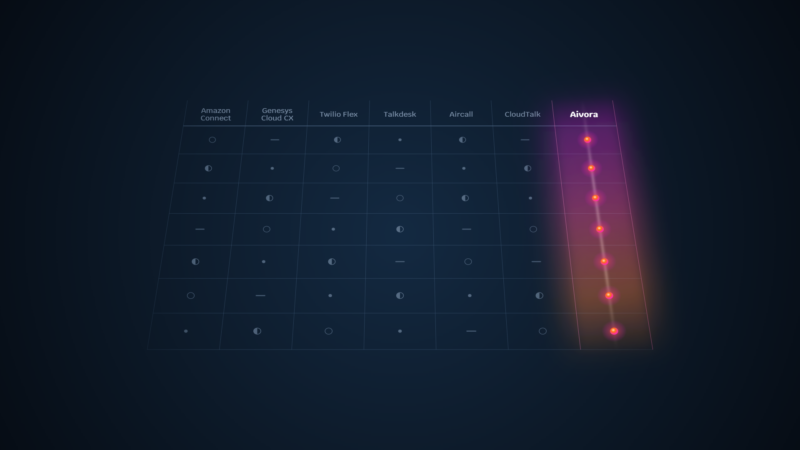
The short answer: it depends on whether you’re buying a set of tools or a finished job. Generalist call platforms such as Amazon Connect, Genesys Cloud CX, Twilio Flex, Talkdesk, Aircall or CloudTalk are excellent, highly flexible tools, but they arrive at your dealership without knowing what a service booking, a manufacturer’s diary or a Monday at 9:05 looks like. All of that has to be built on top. A specialist platform for the automotive sector, such as Aivora, arrives turnkey: it routes by intent, books straight into the live diary in the DMS or the manufacturer’s system, works across voice and WhatsApp in the customer’s own language and leaves a full audit trail for every call. For a dealership, the best call software is the one that turns a call into a booking recorded where it belongs, not the one with the longest spec sheet.
This guide isn’t a brochure. It’s the list of criteria we’d use if we had to choose, including the awkward questions you should be asking us too.
What makes a dealership different from any other business that takes calls?
A dealership doesn’t really take calls: it takes requests. And almost all of them end up in a system that isn’t the phone.
- The service booking. In our own analysis of aftersales calls handled with conversational AI, published by Ganvam, 73.7% of calls were for the workshop and 45% of booking requests went unanswered. The most common call is also the one that leaves the most money on the table.
- The manufacturer’s diary. For many brands, the workshop diary doesn’t live in your CRM; it lives in the manufacturer’s system. If your call software can’t reach it, it can understand the customer but it can’t give them a slot.
- The Monday peak. A whole weekend’s worth of calls squeezed into two hours, while the service desk is dealing with customers at the counter. Service campaigns and manufacturer recalls cause similar spikes.
- Multi-brand, multi-site. A group with four brands and six sites doesn’t have one diary: it has twenty-four, each with its own opening hours and capacity.
- The call that doesn’t fit any menu. “Someone’s bumped into my rear bumper”, “I want to sell my car”, “Is the van ready yet?”. None of these fits a “press 1 for sales”.
- The advisor’s mobile. Half of the customer relationship runs through personal mobiles that leave no trace in any system.
A generalist contact centre platform can handle all of this. The question is who builds it, how long it takes, and who keeps it running when the summer opening hours change.
Generalist or specialist: what’s the real difference?
Buying a generalist platform is like buying an excellent chassis. Buying a specialist platform is like picking up a car that’s registered, fuelled and ready to drive away.
The chassis has real advantages: you can put any body on it, and it works for any industry. But someone has to design the call flows, connect the DMS, teach the AI the workshop vocabulary, build the reports and keep it all alive. If you have an IT team with time on its hands, or an integrator you trust, it’s a very reasonable choice.
A specialist platform gives up some of that freedom in exchange for arriving with the sector-specific work already done: it knows what a service advisor is, it can tell a service from a bodywork repair, it knows the booking has to end up in the brand’s diary and it understands that a multi-site group needs to see each site separately.
Neither is better in the abstract. It’s a question of where you’d rather put the effort.
The call platforms most often compared in 2026
We’ve grouped the most common options into three families. The information comes from each platform’s website and other public sources as of October 2026; it’s worth confirming the details with each provider.

Cloud contact centres: power for teams with technical resources
Amazon Connect, Genesys Cloud CX, Twilio Flex and Talkdesk are very powerful contact centre platforms, with advanced routing, omnichannel and AI. They’re designed for any industry, so in a dealership the call flows, the DMS connection and the workshop logic are designed and built to order, by your IT team or an integrator.

Cloud telephony: up and running fast, no cabling required
Aircall and CloudTalk replace the physical phone system with one in the cloud, with CRM integrations and AI voice agents. The telephony works from day one. What doesn’t come in the box is any knowledge of how a dealership works: the manufacturer’s diary, routing by type of workshop request, or qualifying a part-exchange valuation.

Specialist platform for the automotive sector
Aivora is a conversational AI platform for car dealerships, dealer groups and garage networks in Spain and Portugal. It handles calls and WhatsApp in the customer’s own language, routes by intent (to a person, a department or a specialised AI agent), books directly into the DMS and into manufacturer diaries such as Service Box, and leaves a complete audit trail for every conversation. It can act as your phone system or work alongside the one you already have, and it connects with any voice platform, CRM or DMS. And it arrives turnkey. Who isn’t it for? Anyone looking for a contact centre platform to serve several industries at once, or who wants to code every call flow themselves.
Comparison table: generalists vs specialist platform
| Platform | Type | Designed for | Books into the live DMS or manufacturer diary | Getting started in a dealership |
|---|---|---|---|---|
| Amazon Connect | Cloud contact centre | Organisations with technical teams, any industry | With custom development | A project with your IT team or an integrator |
| Genesys Cloud CX | Cloud contact centre | Mid-sized and large contact centres, any industry | With custom development or integration | A project with an implementation partner |
| Twilio Flex | Programmable contact centre | Development teams that want full control | With custom development | A development project |
| Talkdesk | Cloud contact centre | Contact centres, with industry editions | With custom integration | Set-up with an integrator |
| Aircall | Cloud telephony | Sales and support teams at SMEs and mid-sized firms | Not its focus | Self-service from the dashboard |
| CloudTalk | Cloud call centre | High-volume sales and support teams | Not its focus | Self-service from the dashboard |
| Aivora | Specialist platform for the automotive sector | Dealerships, dealer groups and garage networks | Yes: DMS and manufacturer diaries such as Service Box | Turnkey |
When we say “with custom development”, it isn’t a criticism: these platforms are designed precisely so you can build whatever you need. Just remember to add that development, and its upkeep, to the cost of the licence.
The seven criteria that really matter in a dealership
Generalist comparisons tend to score the number of integrations, the price per user or the length of the feature list. In a dealership, these seven criteria are a much better guide to whether the software will actually work.
1. Does it integrate with the live diary?
The question isn’t whether it integrates with “the CRM”. It’s whether the booking ends up in the diary your workshop actually works from: the DMS or the manufacturer’s system. An assistant that chats beautifully and then says “I’ll pass the message on to a colleague” hasn’t handled anything; it’s simply put the work off. Ask to see a booking created, confirmed and cancelled in your own diary, not in a generic demo.
2. Does it route by intent and cope with peaks?
A keypad menu forces customers to translate their problem into the language of your org chart. Intent-based routing asks them what they need and sends them to whoever can sort it out: a specific person, a department or an AI agent that completes the request. And the acid test is the peak: what happens when five calls come in at once and nobody can pick up. If the answer is “they wait in a queue” or “they go to voicemail”, your abandonment rate isn’t going anywhere.
3. Does it work alongside your existing phone system?
Many groups already have a phone system, numbers and extensions that work perfectly well. Good call software for car dealerships should be able to plug into what’s already there, usually via SIP, or replace it if you’d rather. Be wary of any project that starts with “first, we need to change all your telephony”.
4. Does it leave a genuine audit trail?
Transcript, summary, linked ticket and, above all, authorship: who answered, who called, and whether there was a person, an AI agent or an automated process behind it. And one figure that hardly anyone measures: whether handovers from the AI to a person actually go through. In Pied Piper’s Service Scheduling Effectiveness study (July 2026, covering large US dealer groups), roughly one in three handovers from AI to a person failed. If your provider doesn’t measure it, your reports will say everything’s fine while the customer hangs up.
5. Does it follow your team away from their desks?
The service advisor is out on the forecourt, the salesperson is on a test drive and the workshop manager is under a car. If calls are only logged when they’re made from a desk, half of the customer relationship disappears into personal mobiles. Ask whether there’s a mobile app, and whether calls made from the mobile are logged in the platform.
6. Does it understand how your customers speak?
“Supports 60 languages” isn’t enough. Test how it copes with regional accents, with European Portuguese and with workshop vocabulary: the ITV (Spain’s MOT), the 60,000 km service, the bumper or the part-exchange valuation. And if your dealership is in a tourist area, how it gets on in English with someone who’s just seen a warning light come on. Aivora is multilingual and adapts to the language of the person it’s talking to, with no “press 2 for English” menus.
7. Who looks after the recordings?
Where recordings are stored, who can download them, how long they’re kept and under which certifications. It’s the first thing any IT director who reads the small print will ask, and it should be answered before the demo, not after you’ve signed. Aivora is ISO/IEC 27001 certified, and only users with the admin role can download audio.
Questions to ask any provider (including us)
Take this list to every demo. If an answer starts with “well, that depends”, ask what it depends on.
- Can I see a booking created, confirmed and cancelled in my live diary, for my brand?
- What exactly happens when five calls come in at once and nobody is free?
- How is a call handed over from the AI to a person, and how do I measure whether the handover went through?
- Do I need to change my phone system, my numbers or my extensions?
- Who sets up the call flows and opening hours, and who changes them when I open a new site or summer hours kick in?
- What does the whole first year cost, adding up licences, usage, implementation, integrations and maintenance?
- How do I see results by site, by brand and by department?
- Where are recordings stored and who can access them?
- How many dealerships already use the solution in Spain or Portugal, and can I speak to one of them?
Red flags
- The double diary. If the AI logs bookings in its own system and someone has to copy them into the DMS afterwards, you haven’t automated the booking: you’ve created another job.
- “We’ll call you back to confirm”. It’s the modern-day sticky note. If the conversation doesn’t end with a confirmed slot, the customer will keep looking elsewhere.
- Dashboards nobody maintains. A drag-and-drop call-flow editor looks great in the demo. Six months later, it’s usually exactly as the implementer left it, apart from that late Friday afternoon when somebody changed something without telling anyone.
- A per-minute price that ignores everything else. A cheap licence with six months of development on top doesn’t work out cheap.
- A demo with one brand and one site. If your group has several, ask to see it working with several.
- Handovers nobody measures. If nobody shows you that figure, it’s because nobody is tracking it.
When does a generalist make sense?
There are cases where a generalist is the best choice, and it’s worth saying so:
- Groups with businesses outside the motor trade that want a single contact centre for everything (real estate, wineries, construction).
- Organisations with their own development team that prefer to build and maintain their own call flows, or that already run on a particular cloud.
- Small dealerships that only need telephony: numbers, extensions, an app and not much more. For that, cloud telephony does the job perfectly well.
And it isn’t always an either/or decision. If you already have a generalist contact centre and it works, a specialist platform can sit alongside it via SIP and take care of what the generalist doesn’t bring: workshop intent, the manufacturer’s diary and intelligent overflow.
Where does Aivora fit in this comparison?
Aivora is the specialist platform on the list. It doesn’t compete on the number of industries or the number of generic integrations: it competes on making sure every call to a dealership ends with the job done. It handles voice and WhatsApp in the customer’s language, routes by intent, books into the DMS and manufacturer diaries, acts as your phone system or works alongside yours, and leaves an audit trail for every conversation, including those from the team’s mobiles. And it arrives turnkey: getting started is on us, and when your opening hours change or you open a new site, we take care of that too.
See plans and pricing or get in touch and we’ll show you it working with your brand and your sites.
FAQ
The one that turns a call into a request that’s resolved and recorded in the right system. For most dealerships and dealer groups, that means software that routes by intent, absorbs peaks, books into the live diary in the DMS or the manufacturer’s system and leaves an audit trail. Generalist platforms such as Amazon Connect or Genesys can do this with custom development; a specialist platform for the automotive sector such as Aivora has it built in and arrives turnkey.
A generalist provides the building blocks (telephony, queues, AI, integrations) for any industry, and your team or an integrator builds the business logic on top. A specialist automotive platform arrives with that logic already in place: service bookings, manufacturer diaries, multi-brand, multi-site and dealership vocabulary. The generalist gives you more freedom; the specialist platform means less of a project.
Yes, if you have a technical team or an integrator to build the call flows and the connection to your DMS and the manufacturer’s diary. Amazon Connect is a very powerful platform, but it doesn’t come ready-made for the way a dealership operates.
Seven things: integration with the live diary (DMS or manufacturer), intent-based routing with overflow during peaks, compatibility with your existing phone system, a complete audit trail with authorship, logging of calls made from the team’s mobiles, understanding of the customer’s language and vocabulary, and secure storage of recordings.
Yes. Aivora connects to voice services via SIP and can ring your existing extensions inside its call flows, so it can be added as an intelligent layer without changing your numbers. If you’d rather not have a phone system of your own, Aivora can take on that role completely.
By combining three measures: routing by intent so every call reaches someone who can deal with it, sharing the load with sequential or round-robin ring groups, and adding overflow to a virtual assistant that answers during peaks and out of hours and books straight into the workshop diary. That way the same team answers better, and the calls that used to be missed are answered and logged.
It depends on the model: some platforms are pay-as-you-go, others charge per user or per seat, and almost all charge extra for AI. To compare like for like, add up the cost of the whole first year: licences, usage, implementation, DMS integration and maintaining the call flows. You can see Aivora’s plans on our Plans and pricing page.
Yes. Aivora is multilingual and adapts to the language of the person it’s talking to, which is particularly useful for dealerships in tourist areas or with international customers living locally.
With most generalist platforms, your administrator, your IT team or your integrator. Aivora arrives turnkey, and changes are on us too: just tell us what’s changing (opening hours, a new advisor or a site that’s starting to open on Saturdays) and we’ll apply it.